Open Science Award 2026: AbSolution and ENCORE
7 September 2026
How does your project make science concretely more open or accessible than it was before?
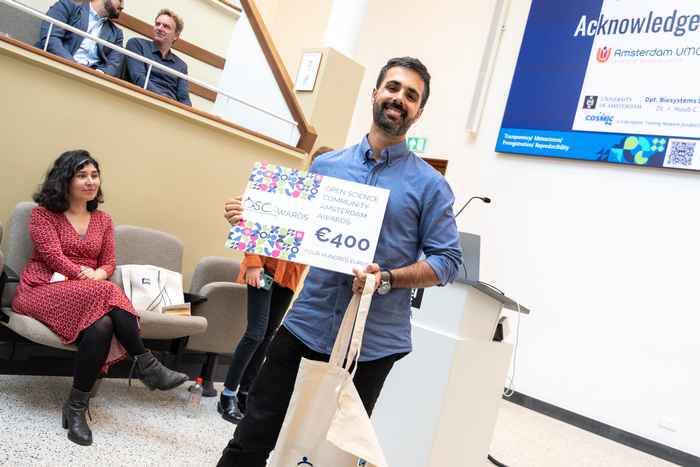
PhD candidate at Amsterdam UMC Rodrigo Garcia Valiente: “Our project makes science more open by turning advanced immune-repertoire analysis into an open-source, code-free workflow that preserves full computational transparency. AbSolution lets non-programmers explore complex immune data interactively while capturing data, code, parameters, software environments, system information, figures, reports, and notes into a self-contained ENCORE compendium that others can inspect, rerun and reproduce. More importantly, it provides a proof of concept beyond immunology for reproducible interactive science across data-intensive fields.”
Who is being reached or heard thanks to this project, who previously remained out of sight?
“It reaches researchers who generate or interpret immunological data but often lack dedicated bioinformatics support: clinicians, immunologists, experimental scientists and students. By lowering coding and infrastructure barriers while keeping reproducibility standards high, the project helps these users participate more independently in computational immunology and makes their analytical decisions more visible and shareable. Our goal is to offer interactivity, accessibility and reproducibility, all in one.”
What was the biggest challenge you encountered, and how did you/your team address it?
“The biggest challenge was reconciling the flexibility of interactive analysis with the rigor of reproducible scripted workflows. User choices, parameters, and reactive steps are normally hard to record. We addressed this by integrating dynamic decision capture, controlled software environments, and ENCORE, our field-agnostic framework for reproducibility. Finally, we validated the exported workflow through an independent CODECHECK review.”
If other researchers were to adopt one thing from your project tomorrow, what should it be?
“Go for it and dare to build accessibility and reproducibility together!
But think it through from the start, not as an afterthought. Every click, parameter, dataset, software version, and note that shapes a result should be captured in a structured, shareable export, so interactive exploration by anyone can become reproducible science for anyone. Of course, feel free to follow our approach. It is worth the effort!"
Open science is a collective effort; behind this project stands a team. Rodrigo Garcia Valiente works on this together with: Charisios Triantafyllou, Barbera van Schaik, Aldo Jongejan, Samuel Langton, Sabrina Pollastro, Dornatien Anang, Jeroen Guikema, Niek de Vries, Huub Hoefsloot & Antoine van Kampen (Amsterdam UMC, Bioinformatics Laboratory, Epidemiology and Data Science)

AbSolution is an interactive R application for analysing BCR and TCR repertoires, allowing exploration of hundreds of sequence‑derived features (such as physicochemical and mutation‑related properties) across clonal populations. Through integration with ENCORE and an independent CODECHECK review, all analyses are captured in a fully traceable and reproducible workflow.
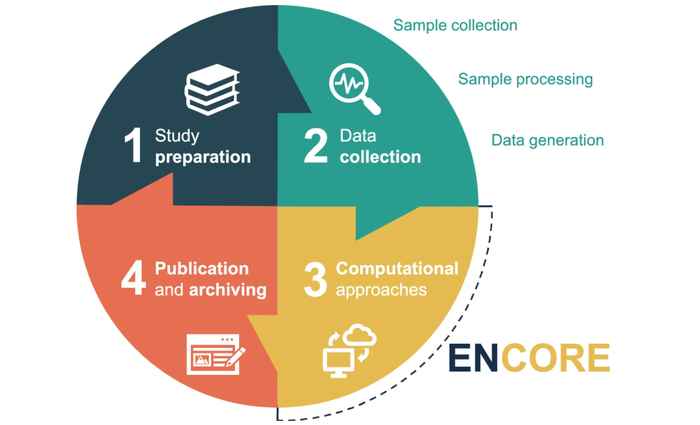
ENCORE (ENhancing COmputational REproducibility) is a generic framework that brings together all components of a computational project — data, code, results and documentation — in a single standardized, well‑documented directory structure. This enables others to understand the analyses, rerun them and transparently reproduce the results, regardless of domain, programming language or infrastructure.